The Lessons That Stay With Them Long After the Classroom.

Fifty-two short stories about navigating life with purpose, perspective, and heart.
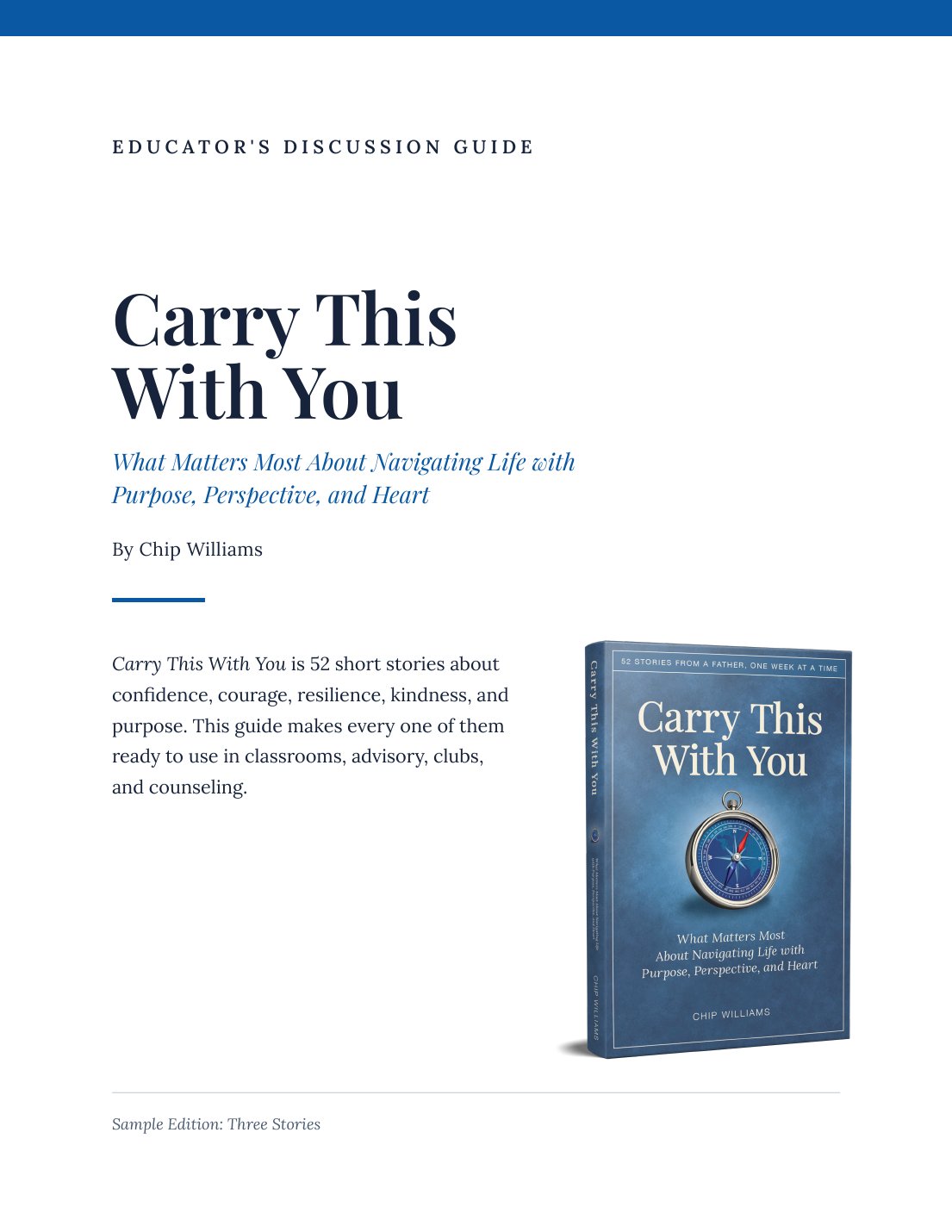
Educator's Discussion Guide cover

FREE Discussion Guide with every school order

Covers all 52 stories

N S E W Carry This With You by Chip Williams
Classroom Discussion Graduation Gifts Sports Teams Clubs & Honor Societies Counselors PTA Gifts

For PTAs & Administrators

A Gift With Meaning.

A thoughtful, budget-friendly gift for the graduating class — or a meaningful way to recognize teachers, staff, and anyone who's quietly held your school together this year. Easy to order, easy to love.

For the Classroom

Ready for Any Period.

A ready-to-use resource for advisory periods, homeroom, or classroom discussion. Fifty-two short stories, each with its own prompts built in — nothing extra to prepare.

More Than Another
Required Read.

Some assigned reading gets forgotten the week after the test. Carry This With You is a collection of 52 memorable, short stories — on belief, action, resilience, connection, and legacy — each one offering a different perspective on what matters most: the value of real conversation, the courage to begin before feeling ready, the difference between being busy and being present.

And here's a unique perspective — the goal isn't to get through this book. It's to let it get through to you.

"These messages are powerful and incredibly timely, especially as we're all trying to find our way. The book strikes a really strong balance between experience, reflection, and meaningful takeaways."

— School Principal, Fairfield County, CT

5

Core Pillars

52

Weekly Stories

36

Life Themes

This book was never meant to be a book. What started as weekly messages from a father to his two sons became fifty-two stories moving through five stages of a life lived with intention. Read them in order, or open to whatever meets a student where they are right now. What resonates during one chapter in a student's life may speak to them differently in another. Because the words don't change — you do.

Belief

Confidence, Purpose, and Self-Discovery — believing you belong, before you take the first step.

Action

Effort, Growth, and Momentum — turning belief into motion, one imperfect step at a time.

Resilience

Weathering Change and Finding Strength — learning to bend without breaking.

Connection

Kindness, Gratitude, and the Power of Others — remembering that no one carries everything alone.

Legacy

Purpose, Meaning, and Perspective — asking what you're building that will last.

Did You Know?

One of the fifty-two stories, "Be the Bean," is about a conversation I had with a baseball player named Andrew, who I coached when he was twelve — about dealing with adversity. It's a moment about how the challenging times can either harden you or shape you, depending on how you respond. Years later, Andrew wrote about that exact moment in his college application essay — and one admissions office even wrote back just to tell him how much they loved it.

A Discussion Guide That Works on Your Schedule.

FREE with every school order

Each of the fifty-two stories comes with its own one-page guide: a brief recap, a before-you-read warm-up, three questions worth talking about, a try-this-week prompt, a short writing reflection, a pairing suggestion, and one line worth remembering.

Story in Brief Before-You-Read Warm-Up 3 Talk-About-It Questions Try This Week Write About It Pairs Well With A Line to Remember

Built to fit a ten-minute advisory period or a full thirty-minute discussion — no extra prep required. A sample of the guide, complete with three stories, is ready for you to view right now.

This value-added, 52-story digital discussion guide comes at no extra cost when ordering books for your school.

View the Sample Guide

"Reading through this reminds me that it's okay to take a step back and take that moment for myself and my students."

— High School Teacher

"I share these with my students in morning meeting — it definitely lends to some great conversations."

— High School Teacher, Coach, Dad of Three

A Teacher's Monthly Ritual.

At a high school in Bedford, New York, Chris has built a monthly routine around the weekly messages. Once a month, he turns one into a handout he calls "A Little Chip of Wisdom." Students read the story, then write a journal reflection that he collects. What comes back has surprised him: students writing honestly about who they are, what they value, and who they're still becoming — the kind of writing that stays with a teacher long after the bell rings.

"It's been a totally different approach to my teaching and has definitely allowed me to connect with my kids in a whole new way."

— High School Teacher, Westchester County, NY

A Graduation Gift
They'll Actually Keep.

Every graduating class deserves something that marks the moment — but most gifts are forgotten by the time the boxes are packed. These fifty-two stories find a graduate wherever they land next: starting college, moving up to high school, beginning a first job, or facing whatever milestone comes after that one. They're universal reminders — the kind everyone needs, especially when life moves fast.

And for PTAs and class funds working with a limited budget, it's an easy yes — a gift meaningful enough to mark the occasion without needing a large line item to do it.

Also a moving-up gift for 8th graders heading into high school.

"This book isn't a manual, and it isn't a lecture. It's a compass — a way to navigate the moments that shape us."

— From the Book

The Perfect Fit for Your School.

→

A graduation gift for the entire senior class

→

A read for honor societies and student clubs

→

A classroom discussion tool, story by story

→

An advisory period or homeroom opener

→

A resource for counselors and student support

→

A PTA-sponsored gift for every graduate

Simple Pricing for Schools.

Paperback retail: $15.99

CopiesPrice eachSavings
25–99$12.99Save $3 a copy
100–199$10.99Save $5 a copy
200+$9.99Save $6 a copy

Shipped directly to your school in 10–14 business days. Free digital Educator's Discussion Guide with every order.

Larger school or district? Request a quote.

I'd like to hear from you.

Have a question about bringing this to your school? Just reach out — I'll follow up directly, usually within a day or two. No distributor and no middleman. Larger school or district? Ask for a quote.

"No matter where life takes you,
you already hold the compass."

— From the Afterword

From the Book

Whose Voice Are You Listening To?

I was two years into my first real job and I thought I was ready. Then they gave the promotion to someone else — and I had to decide whose voice I was going to listen to.

A marketing role had opened up — one I had been quietly working toward, one that felt like the natural next step for someone who had been showing up every single day with everything they had. I knew the work. I understood the business. And I believed — the way only someone young and hungry can believe — that the right people were paying attention.

They gave it to someone else.

Not someone more prepared. Someone who had simply been there longer. There was no conversation. No explanation. Just a quiet realignment and the message — delivered without words — that what I had to offer wasn't quite enough.

I told myself it didn't bother me. It did.

The discouragement settled in quietly and then stayed. I could feel it bleeding into everything — my energy, my focus, my sense of what I was worth. I still showed up. But something essential had gone quiet inside me. And the longer I sat with it the more I realized I had done something I didn't intend to do — I had let someone else's opinion become my own.

Eleanor Roosevelt said it simply: "No one can make you feel inferior without your consent."

It sounds straightforward until you sit with it. Because the truth is we give that consent more often than we realize — in the moments we shrink in a room where we belong, stay quiet when we have something worth saying, or measure our worth against someone else's judgment of us.

The day I recognized I had a choice — that I could keep carrying their decision or set it down and get back to work — something shifted. I rolled up my sleeves. I kept showing up the way I knew how. Not to prove anything to anyone watching. But because I knew what I was capable of and I wasn't willing to let someone else's oversight become my permanent address.

I stayed. I kept working. Eventually I became the Regional Account Manager for the Northeast and Canada. The marketing role I'd been passed over for turned out to be exactly what it was — a stepping stone.

But the promotion wasn't the point. The point was the decision I made before it arrived.

Your worth isn't measured by likes, grades, paychecks, or titles. It's defined by your character, your effort, your kindness, and your resilience. Owning it means showing up as your authentic self — not because you have all the answers, but because you trust that you belong in the room.

Doubt will creep in. People will misunderstand you. When that happens pause and ask yourself: Whose voice am I listening to right now? Then choose the one that knows your whole story.

And when you do — when you finally stand in your own worth without apology — you'll find it easier to recognize that same strength in the people around you. Because once you stop measuring yourself against others, you stop measuring them too.

Carry This With You

Your worth isn't given.
It's remembered.

There are 51 more stories like this one.

Every one comes with its own discussion guide — free with every school order.

See the Guide Pages

Or read or

From the Book

Make More Pots

One class tried to make a single perfect pot. The other just kept making pots. Only one of them got better.

Progress begins the moment you stop waiting to get it right and start moving anyway.

A professor once divided his pottery students into two groups. The first would be graded on quantity — make as many pots as possible. The second would be graded on quality — make one perfect pot.

At the end of the semester something surprising happened. The students who produced the most pots also produced the most beautiful ones. Through repetition and experimentation they learned, adjusted, and improved with every piece they made. Meanwhile the quality group spent so much time chasing perfection that most produced little worth remembering at all.

I learned that lesson firsthand early in my career.

When I joined a small creative agency, I was determined to put together the perfect new business presentation. The right examples. The perfect flow. Visuals that covered every possible angle. I kept adjusting, refining, second-guessing every detail — paralysis by analysis in its purest form.

Then I gave the first presentation. It wasn't perfect. But it was well received — and that client went on to work with us for over 25 years. Something clicked.

The more presentations I gave the better I got. Each one taught me something the previous one couldn't. I stopped presenting and started having conversations — listening to what prospects actually needed, adapting in real time, building on what worked and quietly dropping what didn't. The foundation was solid from the start. But the mastery only came from doing it over and over again.

That's what the pottery students discovered too. Quality isn't found in the pursuit of the perfect piece. It's built through the willingness to make another one.

So today, think about something you've been putting off because it isn't ready yet. Send the email. Try the idea. Give the presentation. Take the first imperfect step and let the next one be better.

Because the best work you'll ever do won't come from waiting.

It'll come from making more pots.

Carry This With You

Mastery is built one
imperfect attempt at a time.

There are 51 more stories like this one.

Every one comes with its own discussion guide — free with every school order.

See the Guide Pages

Or read or

From the Book

The Bravest Person in the Room

Sixty-five minutes inside an MRI tube that had broken me in eleven seconds. The day before, a five-year-old in a swimming pool showed me how to get through it.

I am claustrophobic.

Not mildly uncomfortable in tight spaces — genuinely, physically claustrophobic. The first time I ever needed a medical scan, I lasted 11 seconds inside the tube before telling them to pull me out. I was sweating before they finished sliding me in.

So when my doctor told me I needed a specific 65-minute MRI at Mount Sinai Hospital — lying on my back, nose an inch and a half from the machine, no way around it — I knew what I was facing. 65 minutes in a space that had previously broken me in 11 seconds.

The day before my scheduled appointment I took my five-year-old son CJ to a swim lesson.

It was a new place. And the moment we arrived I could see it on his face — pure fear. He was small. The pool was big. And everything about that morning was asking him to do something that terrified him.

I watched through the large window as the lesson began. CJ was standing on a small platform built into the pool — in the water, surrounded by other kids, his instructor nearby. He wasn't crying. He wasn't asking to get out. He wasn't saying no.

He was just standing there. Scared. And staying.

A five-year-old. Doing the hardest thing he'd ever been asked to do. Quietly. Without anyone making a big deal of it. Without anyone knowing how much it took out of him.

I have never been more proud of him in my life. He was my true inspiration.

The next morning I drove to Mount Sinai Hospital and I carried that image with me into the room. When they slid me into the tube I focused on CJ standing in that pool. When I felt my body beginning to tighten — that familiar anxiety climbing — I pulled that image back into focus. A five-year-old standing in the water. Scared and alone. And persevering.

If he could do that I could do this.

There were moments in those 65 minutes when I could feel the anxiety trying to take over. Moments when it would have been easy to tell them to stop and pull me out. But every time I came back to CJ. To that platform. To that small, brave act of courage from a boy who had no idea how much he was enduring.

He got me through it.

That's the thing about courage. It doesn't always announce itself. It doesn't always know it's being witnessed. Sometimes the bravest person in the room is the quietest one — in the water, scared, and standing tall.

You see, courage doesn't always roar. And it doesn't always announce itself. Sometimes it might even show up as a five-year-old standing in a pool.

Carry This With You

You don't have to feel brave to be brave.

There are 51 more stories like this one.

Every one comes with its own discussion guide — free with every school order.

See the Guide Pages

Or read or